Skip to content
    SOARS GROUP / WEB DESIGN / BRISTOLExplore the work

    Construction web design in Bristol.Built around the work you want to win.

    Website design for construction businesses working across Bristol and South West. Clear services, credible project evidence and a straightforward route to an enquiry, without losing the character of your business.

    Construction-specialistCustom design & buildSearch-ready foundationsContent your team can manage

    01 / DESIGN IN PRACTICE

    Our own site. Nothing hypothetical.

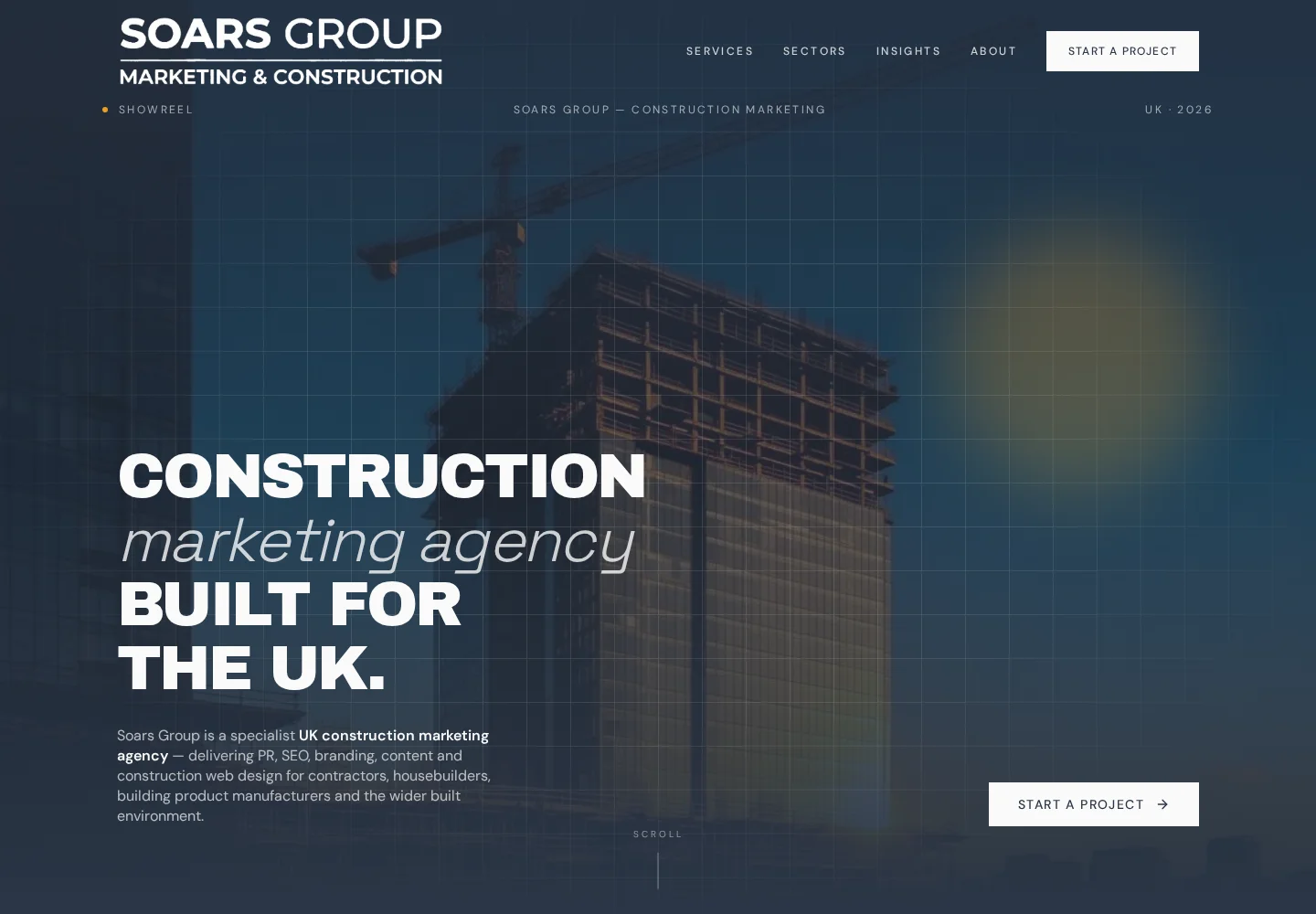
    SOARS GROUP, CONSTRUCTION MARKETING
    Actual Soars Group website on desktop

    Positioning before decoration.The offer, audience and next step are visible together.

    Real content, considered hierarchy.Services, sectors and project evidence have their own place.

    One business. Every screen.The same message stays readable on a phone, not just a big display.

    [ Contractor questions ]

    How long does a website take?

    • Standard build: 8–12 weeks from kickoff to launch. Complex sites with custom integrations: 12–16 weeks.

    What does it cost?

    • Most of our construction website projects sit between £8k and £35k depending on scope. We'll quote precisely after discovery.

    How does our web design process work?

    Soars Group Web Design delivery sequence

    1. Discovery: Workshops, audits and a written strategy document signed off before design.
    2. Design: Wireframes, full UI design and prototype, usually two design rounds.
    3. Build: Front and back-end build, content migration, QA and accessibility audit.
    4. Launch: Soft launch, redirects, monitoring and a 30-day post-launch review.

    What does 2026 construction data tell contractors?

    In its bulletin published on 13 March 2026, the Office for National Statistics estimated that construction output in Great Britain fell by 2.0% in the three months to January 2026. This is a historical market-output measure, not a marketing ROI figure or a forecast of your enquiries. Use it as context when planning which project types and buyers to prioritise.

    Source: ONS, Construction output in Great Britain, January 2026

    BRISTOL / LOCAL CONTEXT

    As a construction business operating in Bristol, your digital storefront is often the first impression you make. While project success is built on tangible quality and strong relationships, securing those initial conversations increasingly relies on a website that communicates your capabilities and aligns with the professional standards of the South West's built environment. Understanding the local market dynamics is crucial for a site that truly converts.

    Bristol's construction sector is vibrant, driven by significant regeneration like Temple Quarter, new residential developments, and consistent demand from its healthcare and aerospace industries. Firms here win work through proven track records, strong local networks, and often, competitive tendering on public and private frameworks. Procurement teams and private clients in the region expect clear, accessible information about capabilities, safety records, and project experience, often scrutinising digital presences before initial contact.

    Understanding Bristol's Digital Procurement Landscape

    For construction firms in Bristol, buying decisions often start long before the first phone call. Major clients, from developers behind Temple Quarter to institutions in the healthcare sector, use websites to pre-qualify potential partners. They're looking for clear evidence of past projects, robust safety policies, financial stability, and relevant certifications. Your website needs to present this information efficiently, offering specific project examples that resonate with the types of work available in the South West. Ensure your case studies detail challenges, solutions, and tangible outcomes, using language that speaks to both technical specifiers and procurement managers. A site that doesn't articulate your value proposition quickly and professionally risks being overlooked in this competitive market.
    Prioritising Mobile Experience for On-Site Decision Makers

    Many decision-makers in Bristol's construction sector are frequently on the move – visiting sites, attending meetings, or commuting. Their primary access to information, including your website, is often via a smartphone or tablet. If your site isn't fast, easy to navigate, and fully functional on mobile devices, you're creating a barrier to entry. Begin by auditing your current site's mobile performance and user experience. Simple actions like optimising image sizes, simplifying navigation menus, and ensuring forms are touch-friendly can significantly improve engagement. A poor mobile experience signals a lack of attention to detail, which can be detrimental in an industry where precision is paramount. Prioritise a responsive design that provides a seamless experience, regardless of device.

    Beyond the Brochure: Websites as Business Development Tools

    In Bristol's dynamic construction market, your website should function as more than just an online brochure; it's a critical business development asset. It should actively generate leads, attract skilled labour to the region, and support your tender submissions. Consider dedicated sections for 'Careers' to appeal to the local talent pool, and robust 'Project' pages that can be directly referenced in bid documents. Instead of just listing services, demonstrate your expertise through thought leadership content – articles discussing local planning challenges, sustainable building practices, or innovations relevant to Bristol's infrastructure. This positions your firm as an authority, fostering trust and opening doors for new opportunities across the South West and beyond.

    02 / THE RIGHT FOUNDATIONS

    What should a construction website actually do?

    Help the right buyer understand your capabilities, trust your delivery and start a useful conversation. Everything else should support that.

    01

    Contractors

    Lead with capabilities, completed work, coverage and the evidence a commercial buyer needs to shortlist you.

    02

    Roofers & specialist trades

    Explain the systems and jobs you actually take on. Show relevant projects and make an enquiry straightforward on a phone.

    03

    Housebuilders & developers

    Organise schemes, availability and development information around the buyer journey, with a clear route to the right team.

    04

    Building product firms

    Help specifiers find applications, technical documents and product information without digging through marketing copy.

    03 / FROM BRIEF TO HANDOVER

    Design is only the beginning.

    01

    UX & Strategy

    Site architecture and conversion paths designed around your buyer's journey.

    02

    Design System

    Custom-designed brand-led visual system, never templated.

    03

    Build & Dev

    Modern, fast, accessible builds on platforms your team can manage.

    04

    SEO Foundation

    Technical SEO baked in from day one, schema, speed, structure, the lot.

    05

    CMS Training

    Hands-on training so your team can update content, projects and case studies.

    06

    Hosting & Care

    Managed hosting, security updates and ongoing performance monitoring.

    04 / PROJECT SPOTLIGHT

    Holborn Studio completed fit-out interior featured in the project story

    Fit-Out & Interiors / 2024

    Holborn Studio

    Website & launch content for a Central London fit-out specialist

    We designed and built a bespoke editorial site engineered around the work itself, full-bleed photography, considered typography, and project films shot across nine completed schemes. The site is fast, accessible, and easy for the team to update.

    Explore the project

    Central London project, not a claim of a local office in Bristol.

    05 / BEFORE YOU COMMISSION

    What should be in your website brief?

    Use these questions to define the work, whether you are replacing an existing website or starting fresh.

    1. 01

      Make the offer unmistakable

      Name the work you want to win, the buyers you serve and your genuine coverage area. A buyer should not have to decode your business.

    2. 02

      Show evidence, not adjectives

      Build project pages around the brief, scope, constraints and finished work. Use approved photography, client comments and relevant accreditations.

    3. 03

      Give every enquiry a clear next step

      Put an obvious contact option beside service and project information. Ask for enough detail to qualify the opportunity, without making the first conversation hard.

    4. 04

      Protect what already works

      Before replacing a site, record its important pages, enquiries and search visibility. Map old addresses to the right new pages instead of sending everything to the homepage.

    5. 05

      Plan for life after launch

      Decide who updates projects and services, what training they need and how you will review enquiries. A website should stay useful after the launch announcement.

    06 / HOW WE DELIVER

    A clear route from idea to launch.

    01

    Discovery

    Workshops, audits and a written strategy document signed off before design.

    02

    Design

    Wireframes, full UI design and prototype, usually two design rounds.

    03

    Build

    Front and back-end build, content migration, QA and accessibility audit.

    04

    Launch

    Soft launch, redirects, monitoring and a 30-day post-launch review.

    07 / STRAIGHT ANSWERS

    Before we talk.

    A website that does your business justice.

    Tell us what you build, who you want to reach and what your current website is missing. We’ll start with the right questions.

    Start your web-design brief